PV Circulator™ Technology
Watch to see how PV Circulator transforms end-of-life panels into virgin-grade materials.
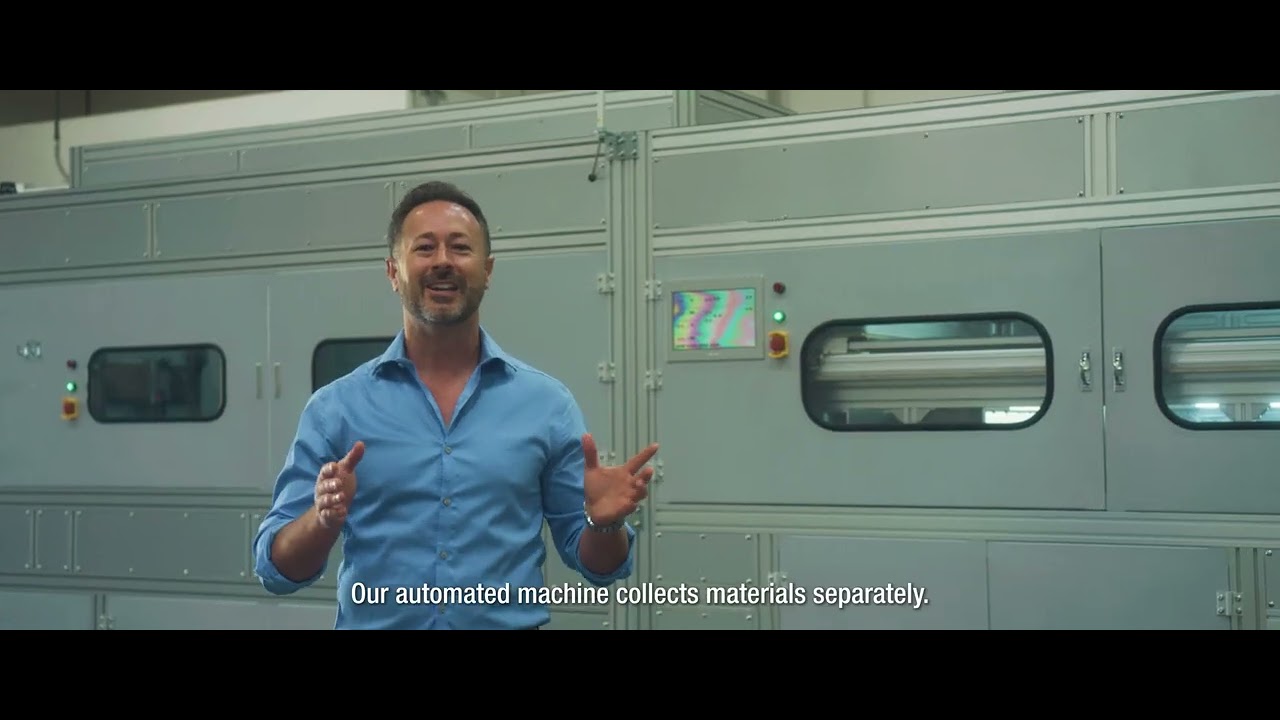
Transforming end-of-life PV panels into 5N–6N high-purity silicon and critical raw materials — securing national energy independence through zero-emission, modular Urban Mining.
R&D Operational
Operational
Operational
Operational
Silicon recycling avoids 85%[1] of CO₂ emissions linked to virgin silicon production. This represents approximately 1.4 tons of avoided CO₂ per ton of recycled silicon[1], compared to virgin silicon manufacturing via the energy-intensive Siemens process (4.7–5.0 tons CO₂e/ton[2]).
Recycling a 300W solar panel avoids approximately 200 kg CO₂ equivalent emissions[4] compared to using virgin materials. Silicon recovery contributes ~35 kg of this benefit, while aluminum recovery (15 kg per panel, 95% emissions reduction) contributes ~165 kg CO₂ savings[4].
Across the entire installed base, recycling end-of-life PV panels will represent 50 million tons of avoided CO₂ emissions by 2050[2], with an additional potential of 110 billion kg total CO₂ emissions reduction and 3.6 × 10¹¹ MJ primary energy savings[2].
Recycled silicon from Urban Mining can be directly reintegrated into photovoltaic module manufacturing with 98% of virgin silicon performance[1]. Solar cells manufactured with recycled wafers demonstrate conversion efficiencies equivalent to virgin cells (15–16%), with module lifespans of 25–30 years and identical performance warranties.
This closed-loop approach creates a sustainable cycle: end-of-life panels → recovery of 5N–6N silicon → manufacturing of new photovoltaic modules with identical specifications. The result is a 30–40% reduction in the overall carbon footprint of solar photovoltaics[1] through integration of recycled materials across the supply chain.
No acid leaching, no solvents, no chemical processing. Fully automated dry physical disassembly without requiring corrosive agents. Protecting local ecosystems while maintaining material purity for remanufacturing.
Room temperature mechanical processing only. No thermal treatment, incineration, or pyrolysis. Precision milling and airflow separation preserve semiconductor properties of recovered silicon while eliminating carbon emissions from combustion.
Airflow-based cooling and separation eliminates water discharge and aqueous waste streams. 100% dry mechanical process protecting groundwater and local water resources from chemical contamination.
99.3% Total mass recovery rate — DTSC Registered and independently verified. Every output stream converted into a tradeable supply chain asset, achieving true closed-loop circularity.
Urban Mining: Multi-Metal Resource Recovery
Australia's Critical Minerals List (2022) — Primary recovered material from PV panel recycling at 99.3% mass recovery rate. Oliver Si flakes preserve semiconductor-grade purity for high-tech applications (semiconductors, solar cells, quantum computing). Alpha Grade composite Si with trace Ag/Cu enables superior conductivity for lithium-ion battery anodes while serving as precursor for electronic-grade silicon refinement. Supporting Australia's silicon supply chain resilience.
Discarded PV modules contain 300–500 ppm silver — equivalent to premium natural ore grades. Physical separation preserves silver particles (15 μm electrode layer) as recoverable high-value metallic concentrate, enabling 97%+ recovery through advanced flotation methods. Silver recovered through Urban Mining reduces dependency on primary mining while supporting strategic domestic reserves.
Copper tabs and ribbon (~200 μm, 1% panel mass) are liberated through mechanical separation and reintegrated into local metallurgical supply chains. Alpha Grade Si composites with trace Cu enhance conductivity for next-generation lithium-ion battery anodes, eliminating need for external nano-carbon additives and reducing downstream processing energy by 40%.
Silicon (Si) added to Australia's Critical Minerals List (2022) — essential for semiconductors, solar cells, and advanced computing. Aligned with Australia's $24.7M National Solar Panel Recycling Pilot (Jan 2026). Multi-metal recovery (5N–6N Si + Ag + Cu) from domestic PV waste supports grid modernisation, defense applications, and semiconductor manufacturing while maintaining resource sovereignty and capturing $7.3B latent value from 1M+ tonnes of end-of-life panels.
Certified Standards & Compliance
Australia's Critical Minerals List (2022) — Silicon output for semiconductor and advanced solar supply chains. Alpha Grade composite material with trace Ag/Cu enables enhanced conductivity for lithium-ion battery anodes and serves as precursor for electronic-grade silicon refinement.
Official CA Registered PV Recycler. PV Circonomy is the U.S. subsidiary of TSGC Inc.
Quality Management Systems — consistent, repeatable production excellence at every facility.
Environmental Management Systems — rigorous ecological impact minimization across all operations.
Registered producer responsibility scheme — compliant with EU WEEE directives for PV module end-of-life.
Life Cycle Impact analysis verified. Full decarbonization pathway validated from collection to output.
Digital Product Passport & AI-driven traceability — EU carbon lifecycle compliant.
🎯 Critical Minerals Alignment
Australia's Critical Minerals List (2022) prioritizes silicon for semiconductor and solar supply chains. Additionally, silver and copper are strategic materials for grid electrification, renewable energy infrastructure, and advanced defense applications. Urban Mining from end-of-life PV panels recovers all three metals simultaneously, creating a comprehensive domestic supply chain resilient to global disruptions.
Strategic Priority: Essential for semiconductors, solar photovoltaic cells, quantum computing, and advanced defense technologies.
Supply Vulnerability: Global production concentrated in China; COVID-19 exposed critical supply chain disruption risks.
Urban Mining Output: 99.3% recovery rate from 1M+ tonnes of end-of-life PV panels — sufficient to support Australia's semiconductor and renewable energy targets.
Strategic Applications: Grid-scale renewable energy storage, electrical contacts, solar cell electrodes, medical devices, and quantum computing applications.
Urban Ore Grade: PV panels contain 300–500 ppm silver — equivalent to premium natural mining ore grades. One million tonnes of end-of-life panels contains ~300–500 tonnes of recoverable silver.
Urban Mining Value: 97%+ recovery rate through advanced flotation; recovered silver directly supports domestic electronics manufacturing, solar expansion, and export revenue.
Critical Role: Backbone of Australia's electricity grid upgrade — required for transmission lines, distribution networks, renewable energy interconnection, and EV charging infrastructure.
Panel Source: PV modules contain ~1% copper by mass in tabs and ribbons (~200 μm thickness) — significant feedstock for battery manufacturing and industrial applications.
Low-Carbon Recovery: Physical separation eliminates need for high-energy copper smelting; recovered copper ready for reintegration into local metallurgical supply chains with minimal processing.
Complete Domestic Supply: Si + Ag + Cu recovery from local PV waste eliminates foreign dependency for critical technology inputs.
Geopolitical Resilience: Aligned with Australia's $24.7M National Solar Panel Recycling Pilot (2026). Federal investment recognizes multi-metal recovery as strategic infrastructure.
Economic Impact: $7.3B latent economic value from 1M+ tonnes of panels — domestic processing keeps value in Australia while supporting quantum computing, semiconductor, grid modernisation, and defense programs.
| TSGC-SolUpcycle PV Circulator — Core Technical Specifications | |
|---|---|
| Processing Capacity | 24–30 Panels Per Hour (Fully automated, continuous throughput) |
| Mass Recovery Rate | 99.3% Total Weight Recovery |
| Output Material Purity | Silicon: 5N–6N (99.999%+) | Aluminum: 99.7% | High-iron-free Ultra-clear Glass |
| Energy Consumption | < 50 kWh Per Ton — Physical separation only, no thermal process |
| Unit Architecture | Standardized 40ft containerized modules — rapid global deployment, on-site urban mining |
| Deployment Timeline | Fully operational in < 6 months from contract to first panel processed |
| Process Type | Dry automated physical separation — zero water, zero chemicals, zero thermal treatment |
| Environmental Footprint | ZERO Water Consumption | ZERO Chemical Discharge | ZERO Toxic Emissions |
| Compliance & Traceability | DTSC Registered | ISO 9001 | ISO 14001 | PV CYCLE | LCI Verified | DPP Traceable (AI-enabled) |
Consumer Electronics Show — recognized as a CES Innovation Awards Honoree for breakthrough clean-tech product design and sustainable engineering.
The "Oscars of Invention." Awarded for one of the top 100 most technologically significant new green-tech products globally.
The solar industry's highest honor — affirming leadership in PV circular economy and automated high-purity material recovery at industrial scale.
Listed among the top 100 global clean technology companies driving sustainable energy infrastructure transitions and resource sovereignty.
Excellence in securing strategic resource sovereignty and achieving zero-waste manufacturing goals in the global circular energy economy.
| Key Metric | Crushing | Pyrolysis | PV Circulator |
|---|---|---|---|
| Recovery Rate | < 70% | 85%–90% | 99.3% |
| Material Purity | Low — mixed glass cullet | Medium | 5N–6N Si (Semiconductor-grade precursor) |
| Energy Consumption | Medium | Very High (thermal) | Low — physical only (<50 kWh/t) |
| Carbon Impact | Medium | High CO₂ + toxic gas | Minimal — LCI verified |
| Carbon Emissions | High | Very High (CO₂ + toxic gas) | Minimal — 0.01 kg CO₂e/kg Si (LCI verified) |
| Deployment | Fixed plant | Fixed plant | Mobile / Modular (<6 months) |
| Chemical Use | None | Solvents / Acid leaching | Zero — acid-free, water-free |
| Traceability | None | Minimal | Full AI / DPP lifecycle tracking |
| Recovery | 99.3% recoveredEvery gram becomes a supply chain asset — zero residual landfill. | <70% (Crushing)30%+ material lost; pyrolysis reaches 90% but still incurs residual waste. |
| Purity | 5N–6N SiliconSemiconductor-grade precursor flakes (99.999%+), Al at 99.7%, ultra-clear glass. | Low-grade mixOnly glass cullet; unable to reclaim high-purity Si or aluminum. |
| Energy | <50 kWh/tonAutomated physical separation — no heat, no combustion, no thermal loss. | Very HighPyrolysis demands extreme thermal energy; crushing is labor-intensive. |
| Sustainability | Zero emissionsNo chemicals, no water — minimal carbon footprint (LCI verified). | High impactPyrolysis emits CO₂ and toxics; acid leaching risks soil & groundwater. |
| Carbon Emissions | 0.94 kg CO₂e/kg Si[1]Ultra-low recycling process emissions — physical separation minimizes thermal and chemical processing. Displacing virgin silicon saves 4.7–5.0 tons CO₂[2] per ton of virgin silicon produced. | 4.7–5.0 kg CO₂e/kg[2]Virgin silicon via Siemens process requires 11–13 kWh/kg energy. Pyrolysis-based recycling with acid leaching: 1.2–2.4 kg CO₂e/kg module feedstock[3]. |
| Mobility | <6 months40ft containers — operational on-site anywhere globally within months. | YearsFixed plants require permitting, construction, and heavy upfront CapEx. |
| Traceability | AI + DPPFull carbon lifecycle tracking — EU Digital Product Passport compliant. | NoneNo infrastructure; cannot meet ESG or EU DPP reporting standards. |
Watch to see how PV Circulator transforms end-of-life panels into virgin-grade materials.
Authors: EPJ Photovoltaics Research Team (ROSI Technology - France)
Published: November 2024 | EPJ Photovoltaics
Cited for: 85% carbon reduction, 1.4 tons CO₂e avoided/ton recycled silicon, 0.94 kg CO₂e/kg recovery process, 98% performance retention
Key Findings: ROSI's high-value recovery process achieves 936 kg CO₂-eq per ton of PV module treatment. Results show 90% impact savings in 9 of 14 environmental impact categories compared to conventional production. System expansion analysis demonstrates significant environmental benefits from high-quality secondary raw materials.
DOI: Available at https://www.epj-pv.org/
Authors: ScienceDirect Research Consortium (China & International)
Published: October 2025 | Science of The Total Environment
Cited for: 4.7–5.0 kg CO₂e/kg virgin silicon, 50 million tons CO₂ avoided by 2050, 97.79% optimization potential, global impact assessment
Key Findings: Conventional recycling pathway generates 43,065 kg CO₂-eq per megawatt. With low-carbon optimization (energy efficiency, transportation, recovery rates), emissions reduce to 951 kg CO₂-eq per megawatt—a 97.79% reduction. Cumulative global potential: 323.53 million tons CO₂-eq savings by 2055 from projected 583.4 GW of retired modules.
DOI: Available at https://www.sciencedirect.com/
Authors: Duan et al., Environmental Impact Assessment Team
Published: October 2024 | Chemical Engineering Journal
Cited for: 42% GHG reduction in recycled modules, 1.2–2.4 kg CO₂e/kg for pyrolysis-based recycling, green solvent methodology
Key Findings: Green solvent recycling (DMI & Deep Eutectic Solvents) reduces global warming potential by 487 kg CO₂-eq compared to traditional nitric acid leaching. DES achieves 99% metal recovery rates, reduces terrestrial ecotoxicity by 742 kg 1,4-DCB-equivalent, and lowers energy consumption to 0.0457 kWh/L vs. 0.238 kWh/L for pyrolysis.
DOI: Available at https://www.sciencedirect.com/